

Theodore Roosevelt National Park is an underrated American beauty. The vast badlands intertwined with natural prairie are a work of art. The badlands evoke a sense of ruggedness and hardship that is seldom found in other landscapes — a ruggedness reflected in the beasts that call the place home.
Roaming the 70,000+ acre park are large herds of buffalo, which were reintroduced into the park decades ago after almost being wiped out due to over-hunting in the 1800s. These large, magnificent animals are a sight to see. Their large muscles and horns combined with their rough coat of fur make an impressive, primitive beast.
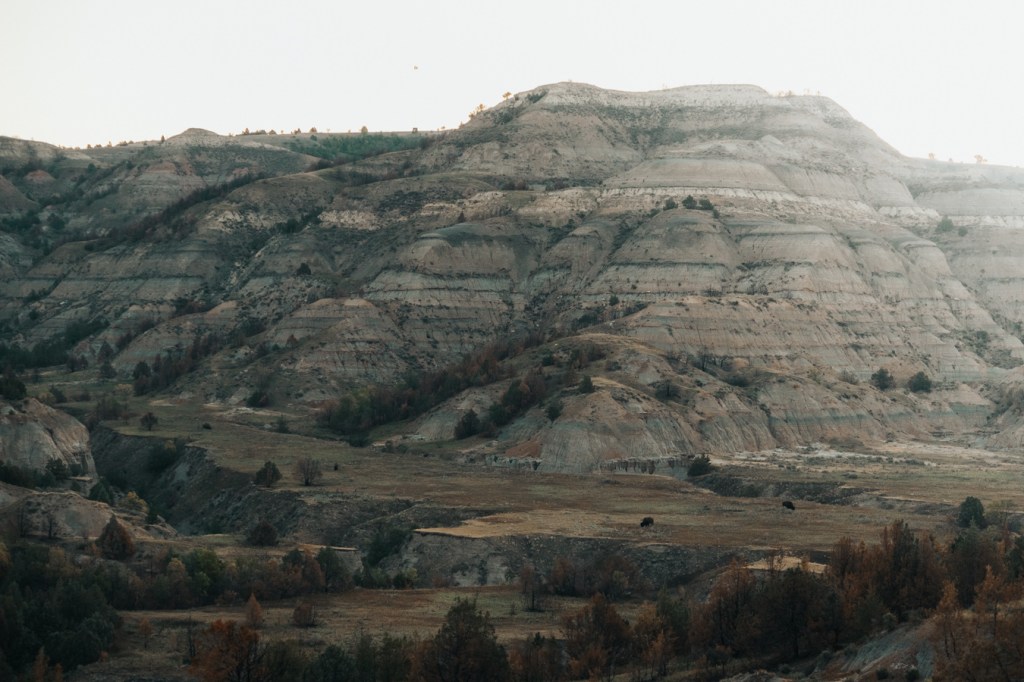
Over the years, the buffalo have grown used to the thousands of humans driving and hiking through their land, staring, and taking pictures of them. Almost oblivious to the people who come there just to see them in their natural habitat. Which is good, because when they do notice you, it doesn’t always turn out great.
Deciding, almost on a whim, to travel to the park to hike the 10.5 mile Buckhorn trail, I thought I knew what would happen that day. Having done this trail many times in the past, I knew it would be barren, empty plains mixed with rugged buttes and probably some wildlife.

Hoping to photograph some of these scenes, I left late in the night to take advantage of the starlight that “Teddy Roosevelt” has to offer — with low light pollution, the stars shine bright in the sky.
Arriving at the park just past midnight, I set up my camera on an overlook to capture the light from the universe. As I was shooting, the bellowing of the buffalo herds just over the ridge let me know they were close. The only other sound was a howling of the coyotes throughout the canyon, which in and of itself was a wonderful spectacle.
As I drove to a parking lot to sleep for a few hours before the sun came up, I passed the herds of buffalo. Hundreds of these giant beasts slept as I passed by, and I even found one wandering through the parking lot where I would spend the night awaiting sunrise.

Waking up, I drove to the trailhead just as the sun was breaking the horizon, with the early morning glow shining on the park. Packing up my bag for the 10-miler, I contemplated bringing the bear spray that I had purchased for a recent trip to Glacier National Park. Putting it back in my pickup, I decided it would be unnecessary as there are no bears within hundreds of miles and the buffalo are gentle giants.
Beginning the hike, it was just as I hoped: The glow of the sun made for an incredible scene on the landscape. Capturing pictures of some far off buffalo, I felt relief knowing this was a great weekend trip to go on.
About half a mile in, I rounded a corner while in a grove of brush and small trees, and there, at 40 yards away, was a full grown, male buffalo.

He entered a small clearing and laid down, staring at me as I stared back at him. I watched as he laid, rolled around, and didn’t do much of anything. Taking a look around, it was a bad situation. To my right was more brush sloping down into a ravine, and the right was sloping up into buttes. In front of me was a 2,000 pound wild animal and behind was the trail I had come only half a mile into.
Knowing I couldn’t go forward or to my right, and not wanting to bail on a hike I wasn’t even a tenth done with, I decided the best case would be to go up the hill and try to make my way around the buffalo. I thought if I could crest the hill, I would be out of his sight and out of danger. Waiting for about ten minutes, watching to see if the buffalo would move, I began to head around him.
Starting to ascend the hill, I spoke quietly to the buffalo, not wanting to startle him with any sudden moves or sounds. Making my way up gently and around the hill, almost tip-toeing, the massive brown head followed my every step.
Having made it halfway across the clearing, I felt ready to get back to the hike when the beast suddenly stood up with his tail sticking straight as an arrow into the air. My heart surged with adrenaline.
As he began his charge, my thoughts went blank and reacted completely on instinct.
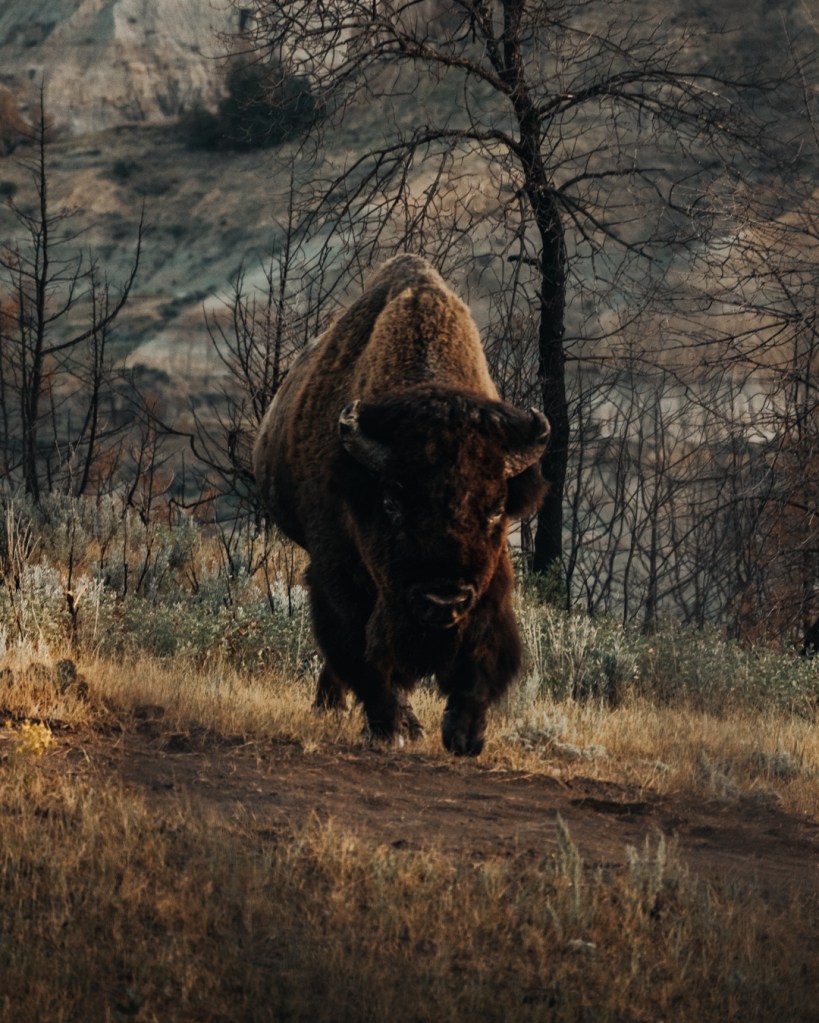
The profanities I yelled to scare him away had no effect, and I began running to my left as he came at me from an angle at my front-right. He covered the 40ish yard distance in a few seconds, while I barely got half a dozen steps.
Turning and seeing him right behind me, I dove off onto my right shoulder as he narrowly missed me, with his head down low and horns pointing up. Looking back over my shoulder while climbing to my feet, I saw that he had pivoted quickly, giving me no chance to avoid him this time.
The next couple of seconds happened so quickly that my memory does not have a clear picture. What I do know is this: he hit me, my camera backpack strap got caught on his horn before breaking off almost instantly, and I rolled off to the side as he tossed me. Then, I watched the buffalo continue running down into the ravine while tossing his head.
What I’m not quite sure about is where I was hit and whether it was from the back or front or left or right side. With all of the rolling and running, it is hard to say exactly where contact was made.
The tear in my hoodie and shirt is on the right side, along with the broken right strap of my backpack, but the way I remember rolling and being tossed make it seem like I would have been hit from the left. In either case, as I got to my feet and watched the buffalo run out of sight, I was shocked to not be dead.

With my stuff now scattered throughout the tall grass, I quickly gathered the things I could find. My camera and backpack were about ten feet away from me — my backpack having been ripped right off my body, even though it was secured by a chest strap.
Shockingly, my camera did not have a scratch on it — even the LCD screen was intact. Deciding my hike for the day was over, I headed back towards my pickup. On the half mile hike back, I reflected on what just happened and what to do now.
My neck hot with pain, I kept touching it and expecting to see blood, knowing a bleeding neck could well be a death sentence. But, I never had anything on my fingers. Getting back to the parking lot, I put my stuff on the tailgate and checked myself over.
No broken bones? Good. No external bleeding? Good. Shirt is ripped. No blood? Good.
I realized that not only was I not hurt, but that I had gotten out of it with little more than a few scratches. Turning around, I looked off in the distance and saw a buffalo come into view, maybe half a mile away. The same one who just charged me.
Staring at the animal that had just attacked me, I didn’t feel anger or hate towards it. I just understood. He felt threatened or scared and reacted in the only primal way he knew how: attack.
Later, I learned buffalo were in rut: The buffalo mating season when males get aggressive. The signs were there — the bellowing, rolling in the dirt, a male by himself — yet I didn’t pay mind to them, and that was a mistake.

This adventure in Theodore Roosevelt National Park is one I will remember for the rest of my life, which is why it’s only fitting that I close this story out with a quote from Teddy himself.
“It is not the critic who counts; not the man who points out how the strong man stumbles, or where the doer of deeds could have done them better. The credit belongs to the man who is actually in the arena, whose face is marred by dust and sweat and blood; who strives valiantly; who errs, who comes short again and again, because there is no effort without error and shortcoming; but who does actually strive to do the deeds; who knows great enthusiasms, the great devotions; who spends himself in a worthy cause; who at the best knows in the end the triumph of high achievement, and who at the worst, if he fails, at least fails while daring greatly, so that his place shall never be with those cold and timid souls who neither know victory nor defeat.”
 Ben Redekopp